
To be perfectly fair, every bit of astrophotography is looking back into time. Even the moon is over one light second away, the sun 8-ish light minutes. On average light (and radio) takes about 43 minutes to get from the Earth to Jupiter. On average radio signals travelling at the speed of light from Earth are five and half HOURS old by the time they reach The Planet Formerly Known as Pluto. To put this image into context the Eagle Nebula is approximately 5,700 light years away, give or take 400 years or so. This field of view is about 1/2° by 2/3°, about two full moons side by side.
Back in 2021 I decided to try my hand at Messier 16, the Eagle Nebula. This region of space was made famous by the Hubble Space Telescope when they created their image of the core of the nebula dubbed the Pillars of Creation. So named because this is an area of intense star development, a stellar nursery. The Hubble image is in very narrow segments of light associated with specific ionizations of specific gasses. When these gases are excited by nearby stellar radiation they change electron state. As they relax they lose that energy and emit light at very, very specific frequencies. We can use that to detect where a wide variety of gasses are in space. The most common are hydrogen, helium, oxygen, carbon, neon, iron, nitrogen, silicon, magnesium and sulfur. The science team designing Hubble felt that hydrogen, sulfur, and oxygen were the most meaningful from an astronomy/astrophysics perspective so those filters are the ones we see most used both scientifically and by extension in the amateur astronomy world.
That’s not what I’m doing here. This data is only using ionized hydrogen (red) and oxygen (green and blue). Because of that my images will look nothing like the Pillars of Creation image that NASA and STSI team created decades ago. But, because I’m looking at very specific frequencies of light I’m able to get an image that would be very challenging from an urban area if I were imaging in full spectrum light, courtesy of a tremendous amount of light pollution in our Bortle 9 backyard.
At the time I took this data, I was very pleased that I was able to get something recognizable as Messier 16.
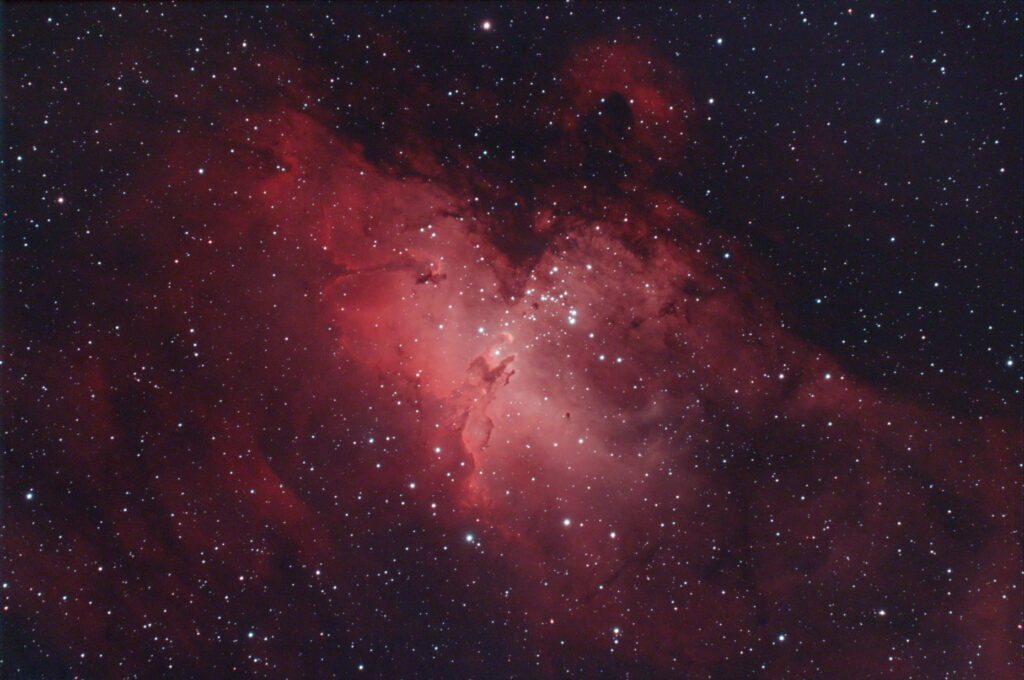
Since then I’ve learned more about image processing. I’ve learned more about how to operate the software I use (PixInsight) and numerous plugins have come out that I consider indispensable. So today, while recovering from an overdose of delicious Thanksgiving food, I decided to look back at some old data and see what I might change and how I might improve some old data. This is what I came up with.

Tech card:
Messier 16 on July 18 and 19, 2021.
Reprocessed November 28, 2025.
72 sub-exposures of 300 seconds through a Celestron EdgeHD 8″ with a 0.7x focal reducer.
Optolong L-eNhance filter and QHY 168C color astronomy camera.